Credentialing Checklist: Complete Provider Document List

The Complete Credentialing Checklist
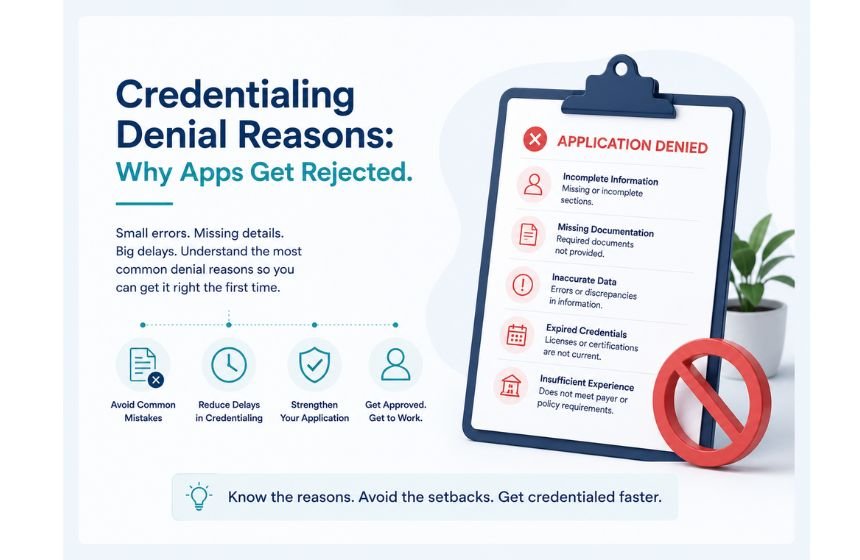
More than half of hospitals and provider groups report measurable revenue losses tied directly to credentialing delays, and for some organizations those losses exceed $1 million annually. The overwhelming majority of those delays trace back to one preventable cause: incomplete documentation at the point of submission — not a complicated background, not a failed verification, just a missing form or an expired document that should have been caught before anything was ever submitted.
This checklist is designed to be used exactly the way it sounds: as a working document. Print it, copy it into a spreadsheet, or hand it to a new provider before their first day — the goal is to gather everything below before a single application goes out, not to discover gaps after a payer sends back a request for more information.
Why the Checklist Matters More Than People Think
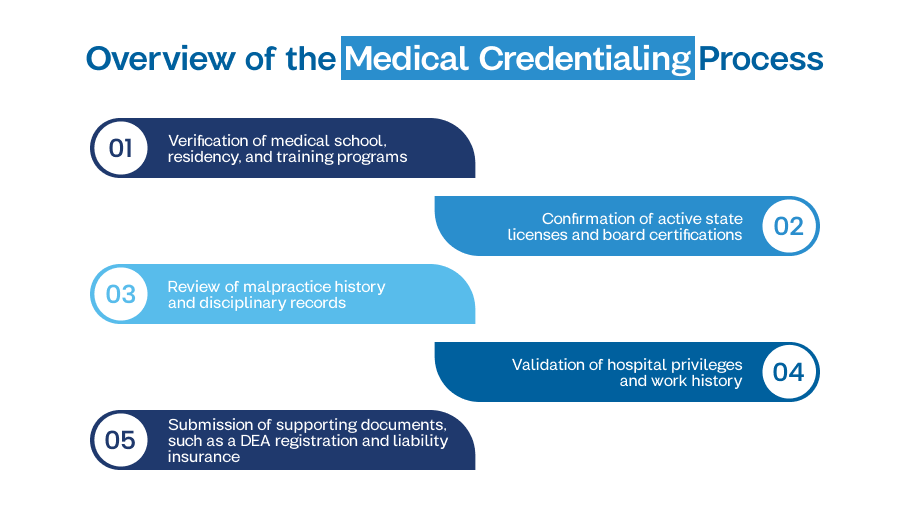
Every document submitted during credentialing gets checked against the original issuing source — a process called primary source verification (PSV). Payers don't take a copy of your diploma at face value; they contact the medical school directly. They don't take your word for an active license; they check the state board's database themselves. This is why accuracy and completeness aren't just formalities — a single inconsistency (a name that doesn't match across two documents, a date that's off by a day) can trigger a manual review that adds weeks to your timeline.
The difference between a 90-day credentialing cycle and a 150-day one is almost always traceable back to gaps in documentation, CAQH maintenance, or inconsistencies across the application — not to anything about the provider's actual qualifications.
Section 1: Core Identity & Personal Information
- Full legal name (exactly as it appears on your license and diploma — no nicknames or shortened versions)
- Government-issued photo ID (driver's license or passport)
- Social Security number
- Date of birth
- Current home and practice addresses, phone number, email
- Individual (Type 1) NPI — apply through NPPES if you don't already have one; this typically takes about 10 business days, so don't leave it until the last minute
- Organizational (Type 2) NPI, if applicable, for group practices
Section 2: Education & Training
- Medical school (or relevant professional) diploma
- Official transcripts, sent directly from the issuing institution when required
- Residency completion certificate(s)
- Fellowship completion certificate(s), if applicable
- Internship records, if applicable
- For NPs/PAs: graduate program diploma and transcripts, plus clinical training/preceptorship hour documentation
Section 3: Licensure & Registration
- Current, active, unrestricted state medical license(s) — front and back / wallet card and wall certificate, with expiration dates clearly visible, for every state where the provider will practice
- DEA registration certificate, current and matching the practice location (required for any prescribing provider)
- State Controlled Substance Registration (CSR), where the state requires one separately from DEA
- If applicable: Interstate Medical Licensure Compact (IMLC) documentation — the Compact now covers roughly 40+ participating states, which can shorten multi-state licensing to as little as 14–21 days for providers already licensed in a member state
Section 4: Certification
- Board certification certificate(s), including the issuing board's name and certification/recertification dates
- National certification for NPs (ANCC, AANP, or specialty-specific) — front and back copies, with expiration date noted
- Any specialty-specific certifications relevant to the provider's practice area
- CPR/ACLS/BLS certification, where required
- Continuing Medical Education (CME) documentation — typically covering the past three years
Section 5: Malpractice & Risk History
- Current malpractice insurance certificate (Certificate of Insurance / face sheet)
- Claims history — including any paid claims or pending suits reported to the National Practitioner Data Bank (NPDB)
- National Practitioner Data Bank (NPDB) self-query report
- Disclosure of any license restrictions, probation, suspension, or state board sanctions — even minor or resolved actions must be disclosed; non-disclosure is treated as dishonesty and can result in permanent denial
Section 6: Work History & References
- Complete curriculum vitae (CV), in chronological order, covering typically the past 5–10 years
- Full explanation of any employment gap greater than 30 days — this is one of the most heavily scrutinized parts of any application
- 3–5 professional references, typically from physicians or NPs familiar with the provider's clinical work, with complete contact information
- Hospital privileges and affiliations, including granting and expiration dates, privilege categories (admitting, consulting, etc.), and committee approval letters — or clear documentation marking this "not applicable" if the provider doesn't hold hospital privileges
Section 7: Federal & Sanctions Screening
- OIG List of Excluded Individuals/Entities (LEIE) screening
- System for Award Management (SAM) debarment check
- Confirmation the provider is not listed on any federal exclusion database — payers now commonly run this as part of enhanced 2026 verification standards, and continuous monitoring means these checks increasingly happen on a rolling basis rather than only at initial credentialing
Section 8: CAQH Setup
- CAQH Provider ID (self-registered or issued via a payer invitation — confirm one doesn't already exist before creating a new one)
- Fully completed CAQH ProView profile: demographics, education, work history, licensure, malpractice, hospital privileges, practice locations
- All supporting documents uploaded in PDF format, clearly and consistently labeled
- Payer authorization completed (global authorization or payer-by-payer)
- Profile attested — an unattested profile is treated as incomplete by most commercial payers, and applications referencing it will be paused until attestation is confirmed
For a full walkthrough of this step, see our guide: <a href="/blog/what-is-caqh">What Is CAQH?</a>
Section 9: Medicare (PECOS) Requirements
- Active PECOS account, tied to a verified NPI in NPPES
- Ownership and control disclosures (relevant to fraud-prevention screening)
- Banking/direct deposit information for EFT setup
- Confirmation that name, taxonomy code, and address match exactly between NPPES, PECOS, and CAQH
For the full comparison of what belongs in CAQH versus PECOS, see <a href="/blog/caqh-vs-pecos">CAQH vs. PECOS: What's the Difference?</a>
Section 10: Telehealth-Specific Requirements (If Applicable)
- Confirmation that video/telehealth software uses end-to-end encryption compliant with current HIPAA standards
- Documented proof of certified training in virtual care delivery
- Any state-specific telehealth licensure or registration requirements for each state where the provider will see patients remotely
Section 11: Practice/Organizational Track (For New Practices)
If you're credentialing a brand-new practice location rather than just an individual provider, a parallel organizational checklist runs alongside the individual provider checklist:
- Tax ID / EIN documentation
- Business license and practice location details
- Organizational (Type 2) NPI
- Malpractice coverage at the entity level
- Banking information for the organization
Both tracks — individual and organizational — typically run concurrently, and delays in the organizational track can hold up every individual provider's enrollment at that location. This makes early preparation especially important for new practices.
Red Flags Credentialing Specialists Look For
Even with a technically complete file, certain items trigger closer scrutiny and slower processing:
- Malpractice claims — paid claims or pending suits reported to the NPDB
- Disciplinary actions — license restrictions, probation, or suspension
- State board sanctions — reprimands or consent orders
- Federal exclusions — appearing on the OIG exclusion list or SAM debarment registry
- Unexplained employment gaps requiring written clarification
- Inconsistent documentation — name variations, date discrepancies, or missing records across submitted files
None of these automatically disqualify a provider, but each one adds a review step that takes time — which is exactly why gathering complete, consistent documentation upfront is the single most controllable variable in the entire credentialing timeline.
Quick-Reference Checklist
Use this as a fast pre-submission scan before anything goes out the door:
- [ ] Government-issued photo ID
- [ ] Active NPI (Type 1, and Type 2 if applicable)
- [ ] Medical/professional school diploma + transcripts
- [ ] Residency/fellowship completion certificates
- [ ] Current state license(s) — all practice states
- [ ] DEA registration + state CSR (if applicable)
- [ ] Board certification(s)
- [ ] CME documentation
- [ ] Malpractice insurance certificate + claims history
- [ ] NPDB self-query
- [ ] Complete CV with no unexplained gaps
- [ ] 3–5 professional references
- [ ] Hospital privileges documentation (or "N/A" noted)
- [ ] OIG/SAM exclusion screening clear
- [ ] CAQH profile complete and attested
- [ ] PECOS enrollment active (if billing Medicare)
- [ ] Name/address/taxonomy consistent across NPPES, CAQH, and PECOS
Frequently Asked Questions About the Credentialing Checklist
What is the single most common documentation mistake?
Inconsistent name formatting across documents — for example, a full legal name on a diploma but a shortened version on an application, or a residency completion date that's off by even a day between two sources. These small mismatches routinely trigger manual review and add weeks to processing.
How far back does my work history need to go?
Most payers require a complete chronological work history covering 5 to 10 years, with any gap greater than 30 days requiring a written explanation.
Do I need a CAQH profile even if I only bill Medicare?
No — Medicare does not use CAQH. However, most providers eventually need both, since Medicare Advantage plans (privately run, commercial products layered on Medicare) frequently do use CAQH for their own credentialing.
What happens if my CAQH profile isn't attested when I submit an application?
An unattested profile is treated as incomplete by most commercial payers, and any application referencing it will be paused until attestation is confirmed. This is one of the most common — and entirely avoidable — causes of delay.
Do PAs and NPs need the same documents as physicians?
The core checklist is largely the same — licensure, education, malpractice coverage, work history — with a few differences. NPs and PAs typically need national certification (such as ANCC or AANP for NPs) and documentation of supervised clinical training hours in addition to the standard items.
How long does it take to gather everything on this checklist?
For a provider who starts early and has ready access to their records, gathering the full document set typically takes a few weeks. Waiting until an application deadline is close is one of the most common reasons practices fall behind — start collection at least 90–120 days before a provider's intended start date.
Is a National Practitioner Data Bank (NPDB) self-query required?
Many payers and credentialing organizations require or strongly recommend a current NPDB self-query as part of a complete file, since it surfaces the same malpractice and disciplinary history that primary source verification will independently confirm.
What if I have an employment gap I can't fully explain?
Provide as much detail as possible — even general context (family leave, further education, relocation) is better than leaving the gap unaddressed. Unexplained gaps are one of the most heavily scrutinized items in any application and are far more likely to cause delay than a gap that's clearly documented.
Do locum tenens providers need to complete the full checklist?
Generally, yes. Temporary or locum tenens providers are still subject to the same primary source verification standards as permanently placed providers, though some payers offer expedited pathways for locum credentialing in specific circumstances.
Key Takeaways
- Incomplete documentation — not complicated backgrounds — is the leading cause of credentialing delays.
- Gather every document in this checklist before starting any application, not after a payer requests something you're missing.
- Consistency across documents (names, dates, addresses) matters as much as completeness — mismatches trigger manual review even when every document is technically present.
- CAQH, PECOS, and any state Medicaid requirements each have their own document and process nuances — review our companion guides on <a href="/blog/what-is-caqh">CAQH</a> and <a href="/blog/caqh-vs-pecos">CAQH vs. PECOS</a> for the full picture.
- Start the checklist process at least 90–120 days before a provider's intended start date to avoid a billing gap.
Managing this checklist accurately across multiple providers, specialties, and states is a significant administrative undertaking — and a single missed item can stall an entire application. If your practice needs help building and tracking credentialing documentation from day one, a dedicated credentialing partner can manage the entire process so nothing falls through the cracks.