Credentialing Denials: Causes, Appeals & How to Prevent Them
Credentialing Denials: Why They Happen and How to Fix Them
A credentialing denial after weeks or months of waiting is one of the most frustrating events in a practice's revenue cycle — and it's more common than most providers expect. More than half of medical practices report experiencing a credentialing-related denial at some point, and roughly one in three billing denials traces back directly to a credentialing error somewhere upstream.
Here's the part that gets overlooked in the frustration: a denial is rarely the final word. Most credentialing denials stem from correctable, administrative-level problems — not disqualifying issues with the provider — and payers are generally required to provide written notice along with a defined path to appeal. Understanding why denials happen and how to respond effectively is often the difference between a provider who ends up in-network within weeks and one who has to restart the entire process from scratch.
The Real Cost of a Credentialing Denial
This isn't just a paperwork inconvenience. When a new provider isn't credentialed on time, the practice cannot bill for that provider's services — full stop. Some estimates put the lost revenue from credentialing delays and denials at up to $100,000 per provider during extended gaps, and ongoing credentialing lapses (not just denials, but any period a provider isn't actively enrolled) have been estimated to cost practices an average of roughly $7,500 per day in lost billing. A 30-day gap, at that rate, can mean over $200,000 in uncollected revenue — and unlike a typical claim denial, lapse-related billing often cannot be appealed or recovered retroactively through normal channels.
This is exactly why understanding both prevention and the appeal process matters — one protects you before a denial happens, the other protects you after.
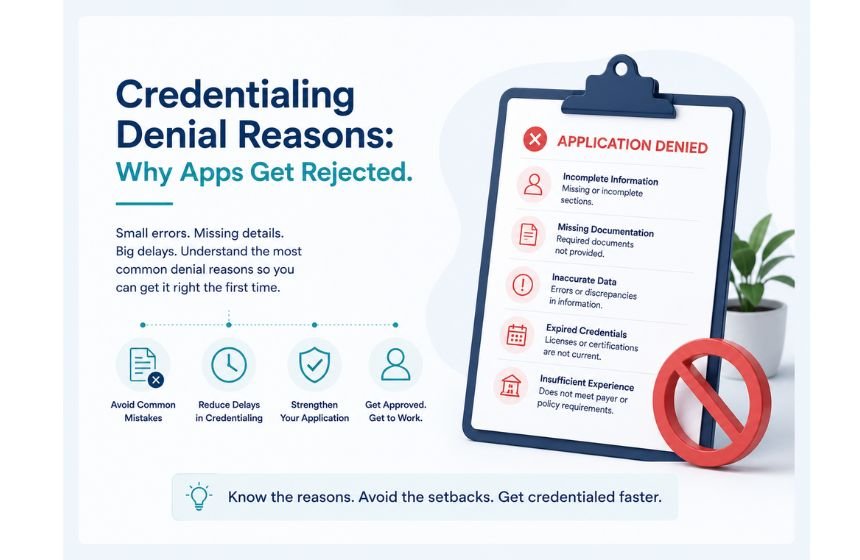
Common Reasons Credentialing Applications Get Denied
1. Incomplete or Missing Application Information
Blank fields, missing signatures, or absent supporting documents are among the easiest reasons for a payer to reject an application without even beginning a substantive review. This is consistently cited as the single most common cause of denial across virtually every source on the topic.
2. Data Mismatches Across Systems
When a provider's name, Tax ID, NPI, or address doesn't match consistently across CAQH, NPPES, and the payer's own application, it gets flagged as a discrepancy that must be resolved before the payer will proceed. Even something as small as "Jon" on one document and "Jonathan" on another can trigger an automatic rejection or hold.
3. Expired or Outdated CAQH Profile
Since most commercial payers pull directly from CAQH, an outdated or unattested profile is one of the leading causes of denial. Remember: CAQH profiles require re-attestation every 120 days, and a lapsed profile is treated as incomplete by most payers reviewing it — even if the underlying data hasn't actually changed.
4. Expired Licenses or Certifications
A state license, DEA registration, board certification, or malpractice certificate that has lapsed — or is close enough to expiration to raise a flag — is a common and entirely preventable denial trigger.
5. Employment Gaps Without Explanation
Unexplained gaps in a provider's work history are heavily scrutinized. A gap of more than 30 days without a written explanation is one of the most common reasons an application gets sent back or denied outright.
6. Failure to Meet Payer-Specific Criteria
Each payer has its own credentialing policy, network needs, and specialty requirements. An application can be entirely complete and accurate and still be denied if it doesn't meet a specific payer's current criteria — for example, applying to a specialty or geographic panel that's currently closed to new providers.
7. No Response to Additional Information Requests
Credentialing reviewers frequently request clarifying information mid-review. Payers work within fixed timeframes, and if a practice or provider doesn't respond promptly, the application can be denied by default — not because anything was fundamentally wrong, but because the response window closed.
8. NPDB or Sanctions Flags
A flagged National Practitioner Data Bank query, a disclosed malpractice claim, or a state board sanction doesn't automatically mean denial, but it does trigger closer scrutiny and can result in denial if not properly contextualized and explained in the original application.
How to Appeal a Credentialing Denial: Step by Step
Step 1: Read the Denial Letter Carefully — Line by Line
This is the single most important step, and the one most commonly rushed. Payers are generally required to state the specific reason (or reasons) for denial. Identify the exact cited issue — "missing malpractice COI," "discrepancy in practice address," "NPDB query flagged" — because a generic appeal that doesn't directly address the stated reason is far less likely to succeed. If the letter feels vague or full of unclear payer jargon, request a detailed written explanation before drafting your response.
Step 2: Gather Documentation That Directly Rebuts the Denial Reason
Collect updated licenses, current certifications, corrected application forms, and any formal verification letters that specifically address what the payer cited. Don't send a broad packet of "everything" — target the documentation to the stated reason for denial.
Step 3: Confirm and Clean Up Provider Data Across All Systems
Before resubmitting anything, verify that the provider's NPI, name formatting, Tax ID, and addresses are now consistent across CAQH, NPPES, and the payer's own records. If the original denial was caused by a mismatch, fixing it in one place without fixing it everywhere else will likely produce the same denial again.
Step 4: Draft a Focused, Professional Appeal Letter
An effective appeal letter is concise, factual, and directly structured around the payer's stated reason for denial. At minimum, it should include:
- Provider identifiers (full legal name, NPI, Tax ID)
- A clear, respectful statement that you are formally appealing the decision
- Direct reference to the specific denial reason cited in the payer's letter
- An explanation of how each cited issue has been resolved
- The updated or corrected documentation attached to support the appeal
Maintain a professional tone throughout, even when the situation is frustrating — appeals reviewed with a combative or accusatory tone are handled by the same people who can choose to expedite or deprioritize your file.
Step 5: Submit Within the Payer's Deadline
Most payers set strict appeal windows — commonly 30 to 90 days from the date of the denial notice. Medicare-specific appeals often follow a more defined federal timeline: a Corrective Action Plan response is generally due within 35 days, with a final reconsideration decision issued within 65 days of the original denial. Missing an appeal deadline can forfeit your right to appeal entirely, forcing a full restart as a brand-new applicant.
Step 6: Follow Up Proactively
Don't submit an appeal and wait passively. Check status regularly through the payer's provider portal or by phone, and keep a written record of every submission date, confirmation number, and contact name. Appeals that are actively tracked and followed up on consistently see faster resolution than those left to sit in a queue.
What If the Appeal Is Denied Again?
A second denial doesn't necessarily mean the end of the road:
- Higher-level review. Depending on payer policy, you may be able to request a formal hearing or committee-level review beyond the initial appeal.
- Correct and reapply. Many payer policies explicitly allow a fresh submission once the underlying issues are fully resolved. Reapplications should clearly note that this is a resubmission and briefly summarize what's changed since the original denial.
- Regulatory escalation. In rare cases — particularly if a denial appears inconsistent with the payer's own stated policy — providers can file a complaint with their state insurance department or consult legal counsel.
- If the deadline was missed. Contact the payer immediately and explain the delay; some payers grant exceptions for good cause (documented illness, natural disaster, payer-caused miscommunication), but this isn't guaranteed, so timely submission is always the safer path.
Preventing Denials: What Actually Works
Because the overwhelming majority of denials come from preventable, administrative-level errors, prevention is disproportionately effective compared to appeals:
- Submit complete applications the first time. Double-check every field, every signature, and every required attachment before submission — not after a rejection notice arrives.
- Keep CAQH continuously current, not just "complete." A profile that was accurate six months ago but hasn't been re-attested within the last 120 days is functionally the same as an incomplete one in the eyes of most payers.
- Standardize name formatting across every document and system — CAQH, NPPES, PECOS, and every individual payer application should use the exact same legal name format.
- Explain every employment gap in writing, even briefly, rather than leaving it for a reviewer to flag.
- Respond immediately to any request for additional information. Payers work on fixed internal timelines; a delayed response can result in denial by default even when the underlying issue is minor.
- Run periodic internal audits. Don't wait for a denial to discover an expired license or a lapsed attestation — build a recurring review into your credentialing workflow.
- Track every deadline in one place. License expirations, CAQH re-attestation dates, and payer revalidation dates should live in a single tracking system, not scattered across spreadsheets, sticky notes, or institutional memory.
Frequently Asked Questions About Credentialing Denials
What's the most common reason credentialing applications get denied?
Incomplete or inaccurate application information — missing signatures, blank fields, or missing supporting documents — is consistently cited as the single most common, and most preventable, cause of denial.
How long do I have to appeal a credentialing denial?
Most payers allow 30 to 90 days from the date of the denial notice, though the exact window varies by payer and should always be confirmed directly from the denial letter. Medicare-specific appeals generally require a Corrective Action Plan response within 35 days and a final decision within 65 days.
Can someone else file an appeal on my behalf?
Yes. Generally, either the provider themselves or an authorized representative — such as a practice manager or attorney — can submit the appeal, provided the letter clearly identifies the signer's authority to act on the provider's behalf.
Does an outdated CAQH profile really cause denials?
Yes, and it's one of the more common causes. Since most commercial payers pull directly from CAQH, an unattested or outdated profile is treated as incomplete, and any application referencing it is likely to be paused or denied until it's brought current.
What happens if my appeal is denied a second time?
Depending on payer policy, you may be able to request a higher-level review or hearing, or you may need to correct the remaining issues and reapply as a new applicant. In rare cases, unresolved disputes can be escalated to a state insurance department.
Can a credentialing denial affect my practice's revenue even before an appeal is resolved?
Yes, significantly. A provider who isn't credentialed cannot bill for services during that period, and unlike many billing errors, credentialing lapse-related denials often cannot be recovered retroactively — making prevention far more valuable than a successful appeal after the fact.
Should I hire a professional to help with a credentialing appeal?
It depends on the complexity. If a denial letter is vague, if a previous appeal was unsuccessful, or if the same type of denial keeps recurring, that's generally a sign of a deeper systemic data issue that a credentialing specialist can identify and resolve more efficiently than repeated self-managed appeals.
Is there a way to avoid most denials without hiring outside help?
Yes — the majority of denials stem from a small set of preventable issues: incomplete applications, data inconsistency across systems, and lapsed CAQH attestation. A disciplined internal process — standardized documentation, regular audits, and a single tracking system for deadlines — prevents most of these before they ever result in a denial.
Do all payers use the same appeal process?
No. Each payer has its own credentialing policy, appeal window, and required documentation format. Always follow the specific instructions included in that payer's denial letter rather than assuming a generic process applies across all payers.
If my appeal succeeds, does that guarantee full network participation?
Not automatically. A successful appeal typically means the payer will proceed with credentialing review as if the original issue never occurred — but final approval, contracting, and effective date assignment still follow the payer's standard credentialing timeline from that point forward.
Key Takeaways
- Most credentialing denials come from preventable, administrative-level errors — incomplete applications, data mismatches, and lapsed CAQH profiles top the list.
- A denial is rarely final. A well-structured appeal that directly addresses the payer's stated reason has a real chance of being overturned.
- Appeal windows are typically 30–90 days — missing that deadline can force a full restart as a new applicant.
- Prevention is dramatically more cost-effective than appeals: credentialing gaps can cost practices thousands of dollars per day in unrecoverable revenue.
- Keeping data consistent across CAQH, NPPES, and every individual payer application is one of the highest-leverage things a practice can do to avoid denials altogether.
If your practice is dealing with repeated credentialing denials, unclear payer communication, or the ongoing burden of tracking appeals across multiple providers, a dedicated credentialing partner can manage the entire process — from initial submission through appeal — so your revenue cycle stays protected and your team stays focused on patient care.