Credentialing Timeline: How Long Does Provider Credentialing Take?
Credentialing Timeline: How Long Does Provider Credentialing Actually Take?
Ask ten different people in healthcare administration how long credentialing takes, and you'll get ten different answers: 60 days, 90 days, 120 days, "it depends." All of them are technically right, because the credentialing timeline isn't a single number — it's a sequence of distinct stages, each with its own timeline, run by different organizations, that all have to land correctly before a provider can bill a single claim.
This guide walks through the real timeline, stage by stage, payer by payer, so your practice can plan accurately instead of guessing — and so you know exactly where to look when an application seems stuck.
Why "It Depends" Is the Honest Answer
Credentialing is not one process — it's actually three separate things that have to happen in sequence or in parallel:
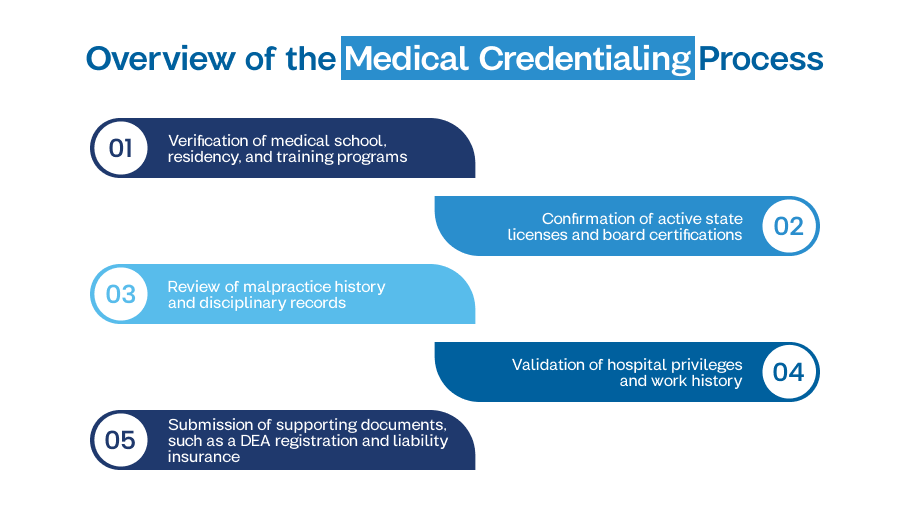
- Credentialing — the verification of a provider's education, licensure, work history, and malpractice record.
- Payer enrollment — formally contracting with an insurance network so the provider is assigned an active, in-network billing number.
- Effective date confirmation — the date the payer officially recognizes the provider as in-network, which is what actually determines when clean claims can go out.
A provider can be fully "credentialed" and still not be able to bill, because enrollment and contracting haven't caught up yet. All three pieces have to be complete before the first clean claim is submitted. This is why practices that only track "credentialing" as a single milestone are often surprised when billing still can't start on schedule.
The General Range: 60–120 Days, With a Wide Spread
Most sources agree on a general range for commercial payer credentialing: 90 to 120 days from a clean, complete application to final approval. Some providers with a flawless application and a responsive payer finish in 30–45 days. Others — particularly those with multi-state licenses, malpractice history, or incomplete initial paperwork — stretch past 150 or even 180 days.
The single biggest predictor of how long your credentialing takes isn't the payer — it's how clean your data is on day one. A CAQH profile with even one missing field doesn't just cost you a few minutes to fix; it can cost you weeks, because your file often has to wait for the payer's review queue to cycle back around to it.
Timeline by Payer Type
Medicare (PECOS)
Medicare credentialing through PECOS is generally the fastest of the major payer categories:
- Electronic applications without a site visit: typically process in about 15 days for the large majority of clean submissions.
- Applications requiring a site visit or a development letter (additional information request): 45–65 days.
- Paper applications: add another 15–30 days on top of standard processing — there is almost no reason to file on paper in 2026.
Overall, most sources place average Medicare enrollment at 60–90 days from submission to active status, factoring in the portion of applications that hit a site visit or documentation request along the way.
Medicaid
Medicaid is the least predictable category, because it's administered state by state with no single national standard:
- Federal rules require states to process applications within 45–90 days, but a significant number of states routinely miss that standard.
- States with automated verification systems tend to close applications in 45–75 days.
- States relying on manual verification often run 90+ days.
- Some individual state examples: Florida and California tend to land in the 45–90 day range; Texas often runs 60–120 days; New York is regularly cited as one of the slowest, frequently landing in the 90–180 day range.
If your practice serves a significant Medicaid population, submit Medicaid applications at the same time as Medicare and commercial applications rather than waiting — Medicaid is often the slowest-moving piece of the entire timeline, so it shouldn't be the last one started.
Commercial Payers
Commercial insurers — Blue Cross Blue Shield, Aetna, UnitedHealthcare, Cigna, Humana, and others — generally take the longest and are the most variable:
- Typical range: 90–150 days, with some specialties and larger networks reporting timelines closer to 180 days in recent data.
- Each commercial payer has its own application portal, its own document requirements, and often an internal credentialing committee that only meets monthly — meaning missing a single monthly meeting cycle can add 30 days by itself.
- Some commercial networks are closed to new providers entirely in certain specialties or geographic regions, regardless of how complete the application is.
Hospital / Facility Privileges
Hospital credentialing for facility privileges typically runs 60–120 days, often overlapping with — but not identical to — a provider's payer credentialing timeline. A provider can be approved for hospital privileges and still be mid-process with commercial payers, or vice versa.
Telehealth Credentialing
Telehealth-specific credentialing tends to move noticeably faster than in-person specialties, with some sources citing ranges as tight as 15–45 days, largely because many telehealth networks have streamlined, digital-first onboarding built specifically for remote providers.
Re-credentialing
Once a provider is in-network, most payers require re-credentialing every 2–3 years to maintain active status. This is a lighter lift than initial credentialing — typically 60–90 days — because much of the underlying data already exists, but it still requires updated primary source verification and is not something that can be ignored or delayed.
A Realistic Week-by-Week Breakdown (Commercial Payer, ~90-Day Track)
Weeks 1–2: Data preparation. This is the phase most practices underestimate. Before anything gets submitted anywhere, confirm:
- Active NPI with correct legal name, taxonomy code, and practice address in the NPPES registry (group practices need both a Type 1 individual NPI and a Type 2 organizational NPI)
- CAQH profile complete, accurate, and attested (budget 3–5 business days for a first-time profile if it's being built from scratch)
- All documents current: state license(s), DEA registration, malpractice certificate, board certifications, CV with no unexplained gaps over 30 days
Weeks 3–4: Simultaneous submission. File Medicare (PECOS), Medicaid, and every commercial payer application at the same time — not sequentially. Filing one payer after another instead of in parallel is one of the most common (and entirely avoidable) reasons a four-month process turns into a year-long one, since each payer's review clock only starts once their application is received. By the end of this phase, you should have a tracking sheet listing every payer, submission date, reference/confirmation number, expected decision window, and a named contact.
Weeks 5–10: Primary source verification (PSV). This is the part of the timeline that feels like nothing is happening — but it's actually where the most time is spent. The payer (or its delegated credential verification organization) is independently confirming your data directly with state medical boards, medical schools, residency programs, and previous employers. Response times from these third parties vary widely and are largely outside your practice's control, which is exactly why clean, error-free initial data matters so much — any mismatch triggers a follow-up request that restarts part of this clock.
Weeks 10–14: Committee review and contracting. Once PSV is complete, the file moves to the payer's credentialing committee — which, for many commercial payers, meets only once a month. Missing a committee's cutoff date by even one day can add a full 30 days to the timeline. After committee approval, contracting begins: effective date assignment, provider directory updates, and internal system setup (including EFT/electronic payment setup), which can take a few additional weeks before the provider is truly ready to bill.
What Causes Credentialing Delays
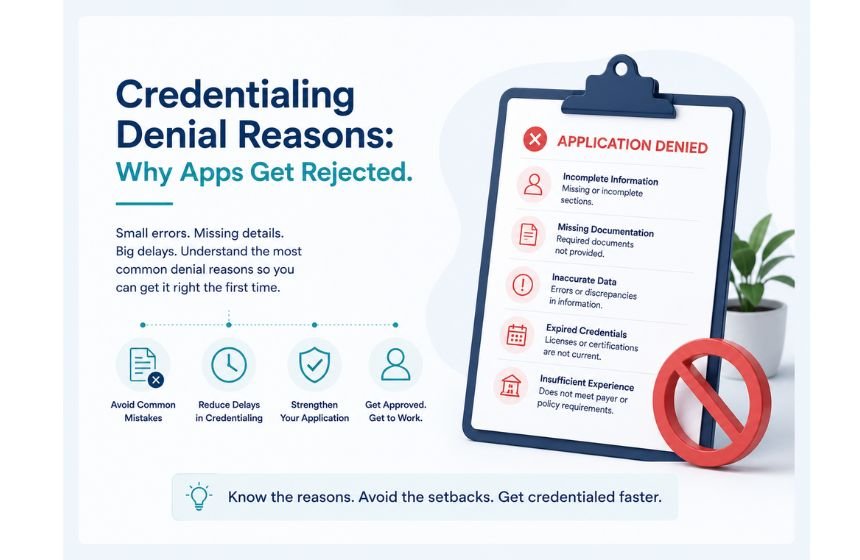
- Incomplete or inaccurate applications — the single most common cause of delay across every payer type. Missing licenses, expired certificates, or outdated malpractice information all trigger additional verification steps.
- Inconsistent name formatting across documents — "Robert" on a diploma but "Bob" on an application, or a residency completion date that's off by even a day between two documents, can trigger a manual review that adds weeks.
- Slow responses from primary sources — medical schools, prior employers, and licensing boards have to confirm credentials, and their response times are outside your control.
- Sequential rather than parallel filing — submitting payer applications one at a time instead of simultaneously.
- Internal payer backlogs — some insurers review new applications only during monthly committee meetings.
- Multi-state licensing — every state where a provider will see patients requires a separate license, and each one requires separate verification. (The Interstate Medical Licensure Compact, now covering 42 states plus D.C. and Guam, can shorten this to 14–21 days for providers already licensed in a member state.)
- Mismatched data across systems — discrepancies between PECOS, CAQH, and individual payer applications commonly trigger holds or rejections.
- Seasonal volume spikes — January and July tend to bring the highest volume of new applications as hospital systems onboard residents/fellows and practices hire for the new year, creating processing bottlenecks industry-wide.
- Lapsed CAQH attestation — a profile that isn't re-attested (every 120 days for most providers) is treated as outdated by every payer that pulls from it, stalling multiple applications at once from a single missed deadline.
How to Reduce Credentialing Time
- Start early. Begin the credentialing process at least 90–120 days before a provider's intended start date — not 60. Starting too late is one of the most common causes of a provider being fully hired but unable to bill for weeks or months.
- File in parallel, not sequentially. Submit Medicare, Medicaid, and all commercial payer applications at the same time so their review clocks run concurrently.
- Get CAQH right the first time. Since most commercial payers pull directly from CAQH, an outdated or incomplete profile creates delays across every payer application simultaneously — not just one.
- Cross-check every document against every other document before submission to catch name, date, and address mismatches before a payer does.
- Use electronic submission wherever possible. Paper applications move to the back of the queue for nearly every payer type in 2026.
- Assign one point of contact within your practice for all payer communications, and follow up proactively — roughly every two weeks — rather than waiting to be contacted.
- Track everything in one place. A single tracking sheet with every payer, submission date, reference number, and expected decision window prevents applications from silently stalling.
- Consider outsourcing. Dedicated credentialing services with established payer relationships and daily (rather than periodic) application tracking have been reported to reduce total credentialing time by roughly 25–30% compared to in-house handling alone.
Frequently Asked Questions About the Credentialing Timeline
How long does credentialing take on average?
Most sources place the general range at 60–120 days for commercial payers, though the realistic average is closer to 90–120 days once you account for typical delays. Medicare via PECOS is often faster (60–90 days on average), while Medicaid varies the most by state (45–180 days).
What's the fastest a provider can get credentialed?
With a flawless, complete application and a responsive payer, some providers finish in 30–45 days. This is uncommon and typically only happens when there are no multi-state licenses, no malpractice history requiring extra review, and no missing documentation anywhere in the file.
Why does credentialing take so long even when my application is complete?
A large portion of the timeline is primary source verification — the payer independently confirming your credentials directly with medical schools, licensing boards, and previous employers. Their response times are outside your control, and many commercial payer credentialing committees only meet once a month, so missing a monthly cutoff can add 30 days by itself.
Can I see patients before credentialing is finished?
You can typically start seeing patients once hired, but you generally cannot bill most payers for those visits until credentialing, enrollment, and contracting are all fully complete. Seeing patients before credentialing finishes is a common source of unrecoverable revenue if not planned for carefully.
Does CAQH being complete mean I'm credentialed?
No. CAQH is the data source payers pull from to begin their own independent review — it doesn't replace or complete a payer's credentialing decision. See our full guide on <a href="/blog/what-is-caqh">what CAQH is</a> for more detail on this distinction.
How long does Medicare credentialing take through PECOS?
Electronic applications without a site visit typically process in about 15 days for the majority of clean submissions. Applications requiring a site visit or additional documentation can stretch to 45–65 days.
Is Medicaid credentialing slower than commercial payers?
It varies enormously by state. Some states with automated systems process in 45–75 days, comparable to or faster than commercial payers. Others rely on manual verification and routinely exceed 90 days, occasionally reaching 180 days in the slowest states.
How often do providers need to be re-credentialed?
Most payers require re-credentialing every 2–3 years. It's a lighter process than initial credentialing since much of the underlying data already exists, but it still requires updated primary source verification and should not be treated as optional.
What's the single biggest cause of credentialing delays?
Incomplete or inaccurate initial applications — missing documents, expired licenses, or mismatched information across systems (like PECOS, CAQH, and individual payer forms) are consistently cited as the top cause of delay across every payer type.
Does outsourcing credentialing actually make it faster?
Practices working with experienced credentialing services often see meaningfully faster timelines, in part because dedicated teams track applications daily rather than periodically, follow up more consistently, and are less likely to submit incomplete files in the first place.
Key Takeaways
- Credentialing, enrollment, and contracting are three distinct steps — all three must be complete before a provider can bill.
- Realistic timelines: Medicare 60–90 days, Medicaid 45–180 days (state-dependent), commercial payers 90–150+ days.
- The most controllable variable is data accuracy on day one — a single CAQH error can add weeks across multiple payer applications simultaneously.
- File all payer applications in parallel, not sequentially, and start at least 90–120 days before a provider's intended start date.
- Consistent, proactive follow-up (roughly every two weeks) meaningfully reduces the odds of an application quietly stalling.
Tracking a credentialing timeline across multiple payers, providers, and states is a significant administrative lift — and errors anywhere in the chain can cost your practice weeks of lost revenue. If your team is spending more time chasing application status than treating patients, a dedicated credentialing partner can manage the entire timeline for you, end to end.