What Is CAQH? Complete Guide to CAQH ProView & Credentialing

What Is CAQH? A Complete Guide to CAQH ProView and Provider Credentialing
If you've spent any time around medical billing, provider enrollment, or healthcare administration, you've almost certainly run into the acronym CAQH. For many providers and practice managers, it's a source of confusion — is it an insurance company? A government portal? A credentialing service? None of the above, exactly. CAQH is the infrastructure that makes modern provider credentialing possible, and understanding how it works can save your practice weeks of delay and thousands of dollars in lost reimbursement.
This guide covers everything you need to know: what CAQH actually is, how CAQH ProView functions, how the registration and attestation process works, and the mistakes that most commonly derail a provider's credentialing timeline.
What Does CAQH Stand For?
CAQH stands for the Council for Affordable Quality Healthcare, a nonprofit alliance formed by health plans and trade associations with a shared goal: reduce the administrative burden of healthcare business processes. Provider credentialing was historically one of the most repetitive, paperwork-heavy processes in the industry — every provider had to fill out a nearly identical application, by hand, for every single health plan they wanted to join. CAQH was created to solve that redundancy.
Today, CAQH's provider data service is the closest thing the U.S. healthcare system has to a universal credentialing form. It is used by the vast majority of commercial health plans, and in many states it functions as a de facto prerequisite for joining a payer network — even though technically no law requires a provider to use it.
What Is CAQH ProView?
CAQH ProView, now more formally referred to as the CAQH Provider Data Portal, is the actual online platform where the credentialing data lives. This is the part people usually mean when they say "I need to do my CAQH."
Instead of submitting separate applications to Aetna, Cigna, UnitedHealthcare, Blue Cross Blue Shield, and every other payer you want to work with, you build one standardized profile inside ProView. That profile holds your:
- Demographic and contact information
- Education and training history
- Work history
- State licenses and DEA registration
- Board certifications
- Hospital privileges
- Malpractice insurance details and claims history
- Practice locations
- Disclosure responses
Once the profile is complete, you authorize specific health plans (or all participating plans) to view it. From that point forward, any payer you've authorized can pull your data directly from CAQH instead of asking you to fill out their own separate form.
It's worth noting the scale here: CAQH's provider database holds information on millions of provider records nationwide, and the large majority of U.S. physicians maintain a complete profile. In many states, all major commercial payers accept the CAQH application as their standard credentialing form.
CAQH vs. Credentialing: They're Not the Same Thing
This is one of the most common points of confusion for providers and office staff alike, and it's worth being precise about it.
CAQH ProView is a data repository. It stores and shares your professional information. Completing your CAQH profile does not mean you are credentialed with any particular payer.
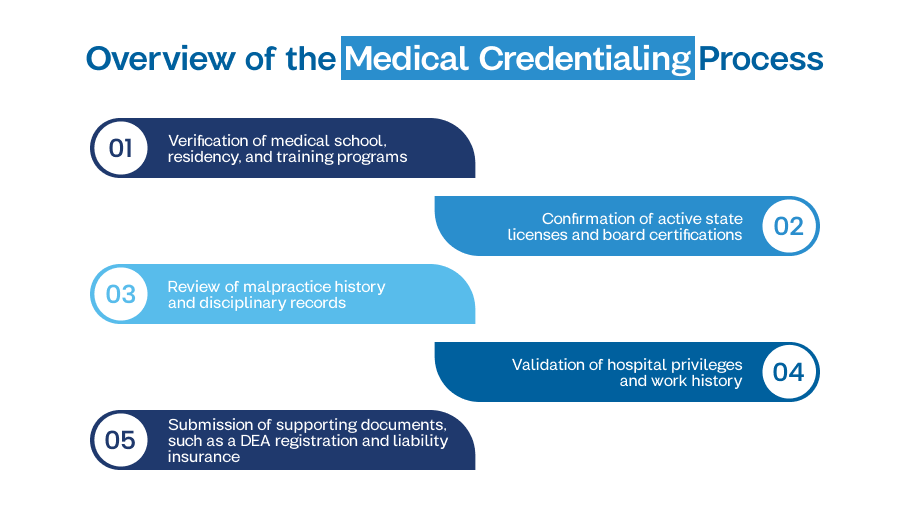
Credentialing is a review process conducted independently by each health plan. Once a payer pulls your data from CAQH, their credentialing team still has to verify it against primary sources (state licensing boards, medical schools, malpractice databases, the NPDB, and others), review it against their own network criteria, and formally approve you.
In other words: CAQH gives payers the data they need to start their credentialing review. It doesn't finish the review for them. A common mistake is assuming that once your CAQH profile shows "complete" and "attested," you're automatically in-network with every payer you've authorized. You're not — each payer still has to run its own approval process, which typically takes anywhere from 60 to 180 days depending on the plan.
Do You Need an NPI Before Creating a CAQH Profile?
Yes. Your National Provider Identifier (NPI) — the unique 10-digit number assigned through NPPES/CMS — is a required field in your CAQH profile and is used across virtually all standard healthcare transactions. If you don't have an NPI yet, get one before you start your CAQH registration; you can't complete the profile without it.
How to Register for CAQH ProView: Step-by-Step
Step 1: Get Your CAQH Provider ID
There are two ways this typically happens:
- Payer-initiated: When you apply to join a health plan's network, the payer checks CAQH for an existing profile. If none exists, they automatically trigger an invitation email containing a temporary ID and registration instructions.
- Self-registration: You can also register directly at the CAQH Provider Data Portal without waiting for a payer invitation. You'll need to provide your name, NPI, Social Security number, DEA number (if applicable), license state, and license number.
Once registered, CAQH assigns you a permanent Provider ID. This ID stays with you for your entire career — it does not reset if you change practices or states — so before self-registering, check with a previous employer or with CAQH support to confirm you don't already have one. Creating a duplicate ID is a common and avoidable error.
Step 2: Complete the Full Profile
The CAQH application is organized into sections covering demographics, education and training, work history, licensure, board certifications, hospital privileges, malpractice history, insurance details, and practice locations. For a provider with documents already gathered and organized, this typically takes one to two hours of focused work for a first-time submission.
Step 3: Upload Supporting Documents
You'll need to scan and upload:
- Current state medical license(s)
- DEA registration certificate (if applicable)
- Board certification(s)
- Malpractice insurance face sheet / certificate of insurance
- Curriculum vitae (CV)
- Any relevant specialty certifications
Use PDF format, and label files clearly and consistently (for example, StateLicense_TX_2026.pdf) so nothing gets misfiled or overlooked during review.
Step 4: Authorize Payers to Access Your Profile
This step trips up more providers than any other part of the process. CAQH will not automatically share your data with any health plan — you have to explicitly authorize each payer (or select the global authorization option, which grants read-only access to any participating plan). If a payer isn't authorized, they cannot see your profile, and from their side, your credentialing application will appear incomplete — even if every field in your CAQH profile is filled out correctly.
Many credentialing specialists recommend selecting global authorization by default, since it's read-only and eliminates the risk of forgetting to add a payer later. You can also authorize a delegate — a practice manager, billing company, or credentialing service — to manage the profile on your behalf, although you as the provider must still personally complete the attestation step.
Step 5: Attest
Attestation is the formal confirmation that everything in your profile is accurate and current. It's a required step, not a formality — an unattested profile is treated as incomplete by every payer viewing it.
The 120-Day Attestation Cycle
This is arguably the single most important operational detail about CAQH, and the one most likely to quietly derail a practice's revenue cycle.
Providers must re-attest their CAQH profile every 120 days, even if nothing has changed. If the deadline passes without attestation, the profile status lapses — and payers relying on that data may treat it as outdated or invalid. This can happen silently: CAQH doesn't always notify the payer, and the payer doesn't always notify your practice. You may not find out your credentialing has stalled until a claim gets denied or a re-enrollment request lands on your desk out of nowhere.
CAQH does send automated email reminders as the deadline approaches, but relying solely on that email is risky — it can be missed, filtered into spam, or sent to an inbox nobody checks regularly. The providers who run into trouble with CAQH are rarely the ones who never set up a profile; they're the ones who built a profile, got credentialed, and then let it lapse because nobody treated re-attestation as a recurring task.
Best practice: Set a recurring calendar reminder 2–3 weeks before each 120-day deadline (note: some states, including Illinois, use a 180-day cycle), and update any information — even minor changes like a new practice address or a renewed malpractice policy — as soon as it happens, rather than waiting for the next attestation window.
Is CAQH Free?
Yes. There is no cost for a healthcare provider to register, complete, maintain, or share a CAQH profile. CAQH generates its revenue from participating health plans and organizations, not from individual providers. If you're ever asked to pay a fee specifically to "register with CAQH," treat that as a red flag — though many credentialing companies do charge a service fee to manage the profile on your behalf, which is a legitimate, separate service.
Common CAQH Mistakes That Delay Credentialing
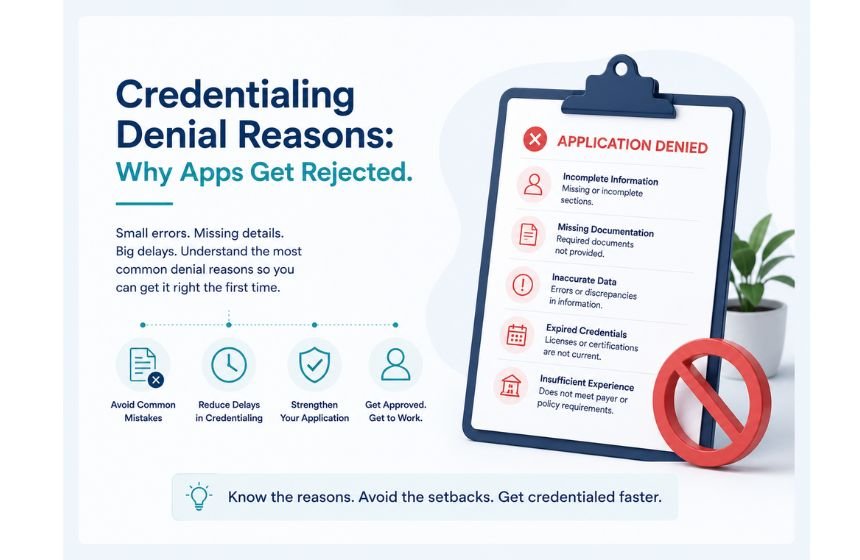
- Incomplete profile fields. Any required field left blank (even one) can hold up review indefinitely.
- Mismatched data across systems. Your name, NPI, and license details need to match exactly across your CAQH profile, the NPPES registry, your state licensing board, and any payer applications. Even small discrepancies (a missing middle initial, an old suite number) can trigger delays.
- Forgetting to authorize a payer. As covered above, this is one of the most common — and most invisible — reasons a payer says your application is "still pending" when your CAQH profile looks finished.
- Letting attestation lapse. Missing the 120-day window without realizing it.
- Expired documents. Uploading a malpractice certificate or state license that's about to expire, without a plan to replace it before it does.
- Archiving an active practice location without confirming with your credentialing team or the relevant payers first.
Can Someone Else Manage Your CAQH Profile?
Yes. CAQH ProView supports group-level access, so a practice manager, billing company, or credentialing service can manage a provider's profile, upload documents, and monitor attestation status. This is common for group practices with multiple providers, since coordinating dozens of individual attestation deadlines manually is a significant administrative load. That said, the attestation step itself typically still requires the provider's personal confirmation — a delegate can prepare everything, but the provider generally has to sign off.
For growing practices — particularly those with a high provider count — this administrative burden is one of the main reasons practices outsource CAQH management and credentialing entirely to a specialized service, rather than trying to track dozens of individual 120-day cycles internally.
Frequently Asked Questions About CAQH
What does CAQH stand for?
CAQH stands for the Council for Affordable Quality Healthcare, a nonprofit alliance of health plans and trade associations focused on reducing administrative burden in healthcare processes, including provider credentialing.
Is CAQH the same as being credentialed?
No. CAQH ProView is a data repository that stores and shares your professional information with authorized health plans. Credentialing is the independent review each payer performs using that data. Completing and attesting your CAQH profile does not automatically mean you are in-network with any payer.
How much does CAQH cost for providers?
CAQH is completely free for providers to register, complete, maintain, and share. CAQH generates revenue from participating health plans and organizations, not from individual providers. Some credentialing companies charge a separate service fee to manage your profile on your behalf, but that is a third-party service fee, not a CAQH fee.
How often do I need to re-attest my CAQH profile?
Every 120 days for most providers and states (Illinois uses a 180-day cycle). You must re-attest even if nothing in your profile has changed, or your profile status will lapse.
What happens if I miss my attestation deadline?
Your profile status can lapse, and payers relying on that data may treat it as outdated. This can happen without direct notification to your practice, meaning credentialing already in progress can stall, or previously active enrollment can be flagged, without anyone catching it until a claim is denied.
Do I need an NPI before creating a CAQH profile?
Yes. Your National Provider Identifier (NPI) is a required field in the CAQH application, so you should obtain it through NPPES/CMS before starting registration.
Can someone else manage my CAQH profile for me?
Yes. CAQH ProView supports group-level and delegate access, allowing a practice manager, billing company, or credentialing service to manage documents and monitor deadlines. However, the provider typically still has to personally complete the attestation step.
How long does it take to complete a CAQH profile for the first time?
For a provider with all documents gathered in advance, the initial profile typically takes one to two hours of focused work, though total turnaround also depends on document upload and any authorization steps that follow.
Does completing CAQH guarantee I'll be approved by a health plan?
No. CAQH only supplies data for the payer's review. Each health plan still conducts its own primary source verification and network approval process, which commonly takes 60 to 180 days depending on the payer.
What's the difference between CAQH and CAQH ProView?
CAQH is the nonprofit organization. CAQH ProView (now also called the CAQH Provider Data Portal) is the actual online platform providers use to enter, store, and share their credentialing data. In everyday conversation, most people use "CAQH" to refer to both interchangeably.
Key Takeaways
- CAQH is a nonprofit organization; CAQH ProView / the CAQH Provider Data Portal is the actual online platform where provider data lives.
- Completing your CAQH profile is not the same as being credentialed — it supplies the data payers use to run their own independent review.
- You must authorize each health plan to view your profile; a complete but unauthorized profile still looks incomplete to that payer.
- Re-attestation is required every 120 days (180 for some states) — missed deadlines are one of the most common, avoidable causes of credentialing delays.
- CAQH is free for providers to register, maintain, and use.
- Managing CAQH accurately — especially across a multi-provider practice — is time-intensive enough that many practices choose to outsource it to a dedicated credentialing team.
If your practice is dealing with stalled payer enrollments, mismatched data across systems, or missed attestation deadlines, a dedicated credentialing partner can take CAQH profile management off your plate entirely and keep every provider's status current — so your team can focus on patient care instead of chasing paperwork.